idea → spec → plugin · LLM pipeline · Research
Hella
A pipeline that turns a rough Minecraft plugin idea into a full spec, then into a plugin that compiles and loads on Paper.
The problem
The slow part of a server plugin is not the code. It is the spec: every decision about what players see, what breaks when the server restarts mid-timer, what an admin has to set up, and which choices only the owner can make. Ask a frontier model for a plugin from a rough idea and it skips most of that, so the code it writes rests on guesses.
What I built
Hella is a pipeline in three steps.
1. Idea to spec (idea_to_spec.py). A rough idea goes in: a few paragraphs, no
decisions. The pipeline drafts a design, finds the forks in it, critiques it, works through
the mechanics, and sweeps for edge cases (admin setup, malformed input, vanilla survival
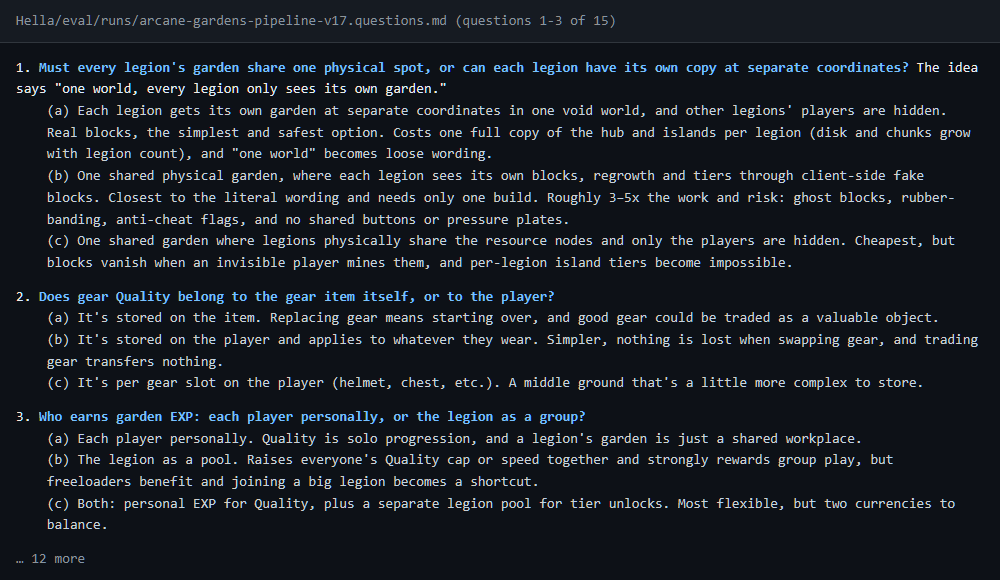
interactions). From that it asks the owner numbered questions. The owner answers any
of them, or says “your call” and the rest are defaulted and listed as
“Defaulted (veto to change)”. Out comes a full spec: player story, decisions, failure
modes, admin setup, build order. Every stage is cached, so a rerun only redoes what
changed.
2. Spec to plugin (spec_to_plugin.py). The spec becomes a Maven project. It only
counts if it compiles and boots on a real Paper 1.21.11 server with
Enabling <name> and no errors, with up to three fix rounds.
3. In-game tests. A throwaway Paper server, mineflayer bots as players, and RCON for admin actions and state checks. The bots play through the flows in the spec and the results go in a table with the log line as evidence.
Results
Spec quality. I scored specs with an LLM judge against a rubric built from my own hand-written Arcane Gardens docs, and the judge had to quote the spec for every point it gave. Same rough idea for both:
- Hella’s spec scored 95.5 and 94.6 in two judge runs (full run from scratch: 290 s).
- Plain Opus scored 48.9-55.7.
- On a second case (WarZone Moving Caves) it was 90.0 and 91.2, versus 53.8 for plain Opus.
There is a big caveat. In these evals a simulated owner answers the pipeline’s questions from about 52 KB of my real Gardens notes, so my own decisions leak in through the answers. Plain Opus got no answers. The gap shows that asking the right questions is worth a lot, but it overstates what the pipeline does on its own.
Plugins that work in-game. Four generated plugins (Arcane Gardens, Moving Caves, a crop contest, a bounty board) all compiled, loaded, and were bot-tested in-game. On Gardens, 120 of 121 flows passed. The tests found real bugs: a cave selection that always failed, a wand that refused every valid block, a prize marked delivered into a full inventory, a catch-up loop that slowed boot to 56 s. Each was fixed at the root and the same bot scripts were re-run on the rebuilt jars, which passed (the catch-up boot dropped to 10 s).
The box
Paper plugins only. No mods, no other languages. “Compiles and loads” is the bar the build step checks automatically; whether a plugin plays right still takes the in-game bot pass. The headline score comes from my own test cases, judged by a model, with my own notes behind the owner answers.
Where it’s going
The next test is a live run on a new idea, with me answering the questions instead of a simulated owner, to see how good the spec is without my notes behind it.
← Back to all work